All-on-4 vs Traditional Implants in Redwood City, CA
All-on-4 vs Traditional Implants Near You
Missing teeth can affect your ability to chew comfortably, speak clearly, and feel confident about your smile. Dental implants can replace missing tooth roots and support crowns, bridges, or full-arch restorations. We provide all-on-4 implants in Redwood City for patients looking to replace most or all teeth in an arch. A consultation helps determine whether this treatment suits your oral health and individual needs.
What Is All-on-4?
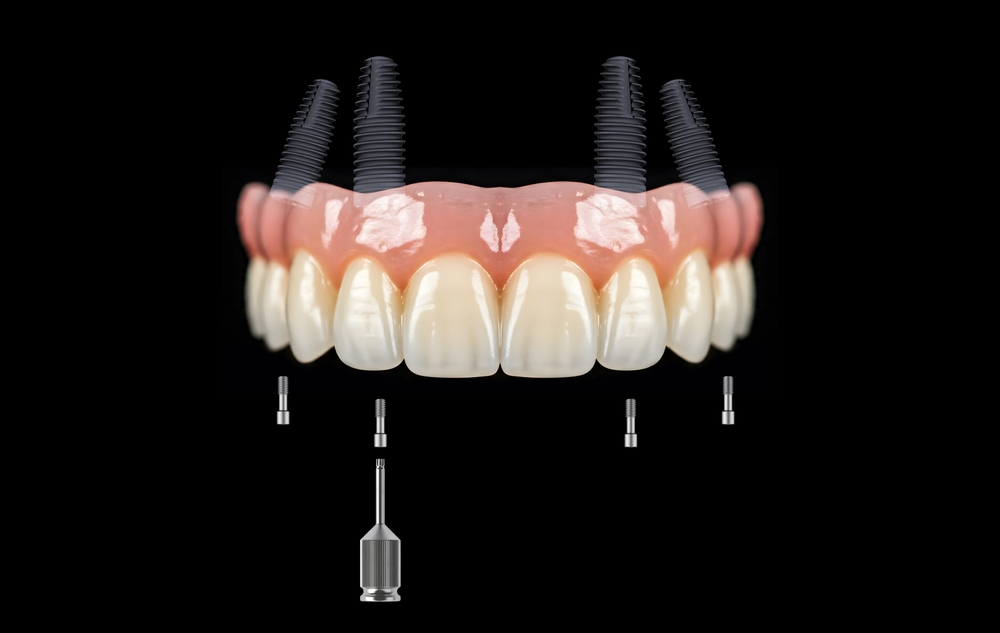
All-on-4 is a full-arch approach that uses four dental implants to support a fixed bridge of replacement teeth. The implants are positioned strategically in the jawbone, and some may be angled to make use of available bone. If the implants have the required stability and the clinical conditions are suitable, a temporary bridge may be attached on the day of surgery. The final bridge is usually fitted after the implants have had time to integrate with the bone. When researching All-on-4 implants near you, it is important to understand that receiving temporary teeth quickly does not mean healing is complete.
The approach differs from replacing each missing tooth with its own implant. It uses a smaller number of implants to support a connected full-arch restoration. For patients missing most or all teeth in one jaw, full arch dental implants can provide a way to support a complete replacement using a carefully planned implant arrangement.
Implant-Supported Dentures vs All-on-4
Both treatments use implants to help stabilise replacement teeth, but the type of restoration and daily routine may differ. Implant-supported dentures can be removable or fixed, depending on the design. A removable denture is taken out for cleaning as instructed, while a fixed bridge remains in place and needs careful cleaning around and underneath it. The standard All-on-4 approach uses four implants to support a fixed full-arch bridge, rather than a denture designed to be removed by the patient.
A removable implant-supported denture may appeal to someone who values being able to take the restoration out for cleaning. A fixed bridge may be preferred by a patient who wants teeth that stay in place during daily activities. If you’re considering a procedure for All-on-4 implants near you, a dentist can examine your oral and dental condition to determine whether it’s suitable for your goals.

Am I a Candidate for Traditional Implants?
Traditional implants may be suitable when you need to replace one tooth or several teeth without replacing an entire arch. Your dentist will assess the intended implant sites and consider your oral and general health. Here are some signs you may be a suitable candidate:
Single gap
You are missing one tooth and would like to consider a fixed replacement.
Several gaps
You have multiple missing teeth that may be replaced with individual crowns or an implant-supported bridge.
Bone support
Your jaw has enough bone at the planned implant sites, or additional treatment may be possible.
Gum health
Any active gum disease or inflammation can be assessed and managed before treatment.
Daily care
You are able to clean around the restoration and attend follow-up appointments.
Health review
Your medical history and medications can be reviewed before surgery.
These are general considerations, not a decision about your eligibility. Our dentist in Redwood City can examine your mouth, review your health history, and use appropriate imaging to evaluate the available bone and nearby structures. If a conventional implant is not the best fit, we can discuss other restorative options and explain their benefits and limitations.
Is There a Faster Option for Implants?
A temporary set of fixed teeth can be attached on the day implants are placed. This approach is often described as teeth in a day. It may reduce the time a patient spends without fixed replacement teeth, but it is not suitable in every case. The implants must have enough initial stability, and additional procedures must be considered before considering the treatment.
Teeth in a day are not the final restoration. The implants still need time to integrate with the jawbone, and the patient may need to follow a diet and restrictions while healing. If the bone needs preparation, implant stability is insufficient, or other factors make loading unsuitable, a staged plan may be recommended instead. A professional will explain what is realistic after examining your mouth and discussing your goals.
Teeth in a Day vs Staged Treatment
The main difference between these approaches is when the temporary restoration is connected to the implants.
Same-day provisional teeth
A temporary fixed bridge may be attached during the implant placement appointment. This can provide an immediate tooth replacement and help avoid a period without fixed teeth. The trade-off is that the provisional bridge needs to be protected while the implants heal.
Staged treatment
Implant placement and attachment of the restoration happen at separate appointments. This may be appropriate when extractions, bone grafting, or other preparation is needed, or when immediate restoration is not advisable. The overall process may take longer, but the sequence can be adapted to healing and the patient’s individual needs.
The appropriate choice depends on initial implant stability, bone quality, gum health, the planned bridge, and the need for additional procedures. A consultation helps clarify the likely stages, follow-up schedule, and what to expect during recovery.
Am I a Candidate for All-on-4 Implants?
This approach may be considered if most or all teeth in an upper or lower arch are missing, severely damaged, or unlikely to be restored. It can provide a fixed restoration without placing an implant for every missing tooth. When looking into All-on-4 implants near you, keep in mind that an in-person assessment is needed to determine whether the available bone and your health support the procedure. Here are some signs you may be a suitable candidate:
Extensive tooth loss
Most or all teeth in one arch are missing or may need removal.
Bone availability
The planned implant sites have suitable bone support, or an alternative plan can be considered.
Gum condition
Existing inflammation or infection can be evaluated and addressed as needed.
Medical suitability
Your health history and medications can be reviewed as part of surgical planning.
Home care
You are prepared to clean carefully around the bridge and attend maintenance visits.
Clear expectations
You understand that temporary teeth and the final bridge are different stages of treatment.
Bone loss does not automatically rule out implant treatment. Whether All-on-4 with bone loss/bone grafting is appropriate depends on the amount and location of available bone, the planned implant positions, and other clinical findings. In selected cases, bone grafts and sinus lifts may be discussed to improve bone support at specific sites.
All-on-4 Recovery Time
Recovery differs with every patient and depends on the extent of surgery, general health, and whether additional procedures are performed. Swelling, tenderness, bruising, and temporary changes in how your mouth feels may occur after implant placement. Post-operative instructions will explain hygiene, diet, medication, and activities to avoid during recovery.
Initial recovery is only one part of the process. The implants need time to integrate with the jawbone before the final bridge is fitted. Following aftercare instructions can help shorten recovery time.
Dr. Shivani Gupta (AAID Associate Member, ICOI Fellow) provides implant care at Peninsula Dental Implant Center. He can explain each stage, review progress, and answer any concerns. The exact recovery timeline is individual, so we base guidance on your procedure.
All-on-4 vs All-on-X
All-on-4 describes a full-arch restoration supported by four implants. All-on-X is a broader term for a similar restoration supported by a number of implants selected for the individual case. A plan may use four implants or a different number, depending on anatomy, bone availability, bite forces, and the design of the final bridge. Here are the details to keep in mind:
Feature | All-on-4 | All-on-X |
Number of implants | Four implants in the standard approach | A variable number based on the treatment plan |
Bone requirements | Requires suitable bone support at selected sites; implant positioning may help use available bone | Depends on implant locations, the number of implants, and the patient’s bone anatomy |
Treatment time | Temporary teeth may be possible on surgery day for eligible patients; the final bridge follows healing | Depends on implant stability, any additional procedures, and the restoration plan |
Cost | Influenced by the bridge, surgery, materials, and any preparatory treatment | Influenced by implant number, restoration design, surgical complexity, and additional care |
Maintenance | Daily cleaning around the fixed bridge and regular professional maintenance are needed | Requires daily care and maintenance suited to the specific restoration |
Longevity | Depends on implant health, bridge wear, hygiene, and follow-up | Depends on implant health, restoration condition, hygiene, and follow-up |
Best suited for | Patients who meet the clinical requirements for a four-implant full-arch plan | Patients whose anatomy or restorative needs call for a different implant configuration |
For All-on-4 implants in Redwood City, we assess whether four implants can provide appropriate support for the planned restoration. If a different configuration may be more suitable, we explain and discuss the practical differences. The number of implants alone does not determine the quality of the result; planning, fit, hygiene, and ongoing maintenance also matter.
All-on-4 Implant Cost and Financing
The cost of full-arch treatment varies according to the work involved. Factors may include extractions, imaging, implant placement, temporary and final restorations, sedation, and any additional treatment needed to prepare the jawbone. The type of material selected for the final bridge and the complexity of the case may also affect the estimate.
Financing may help eligible patients spread payments over time. Approval, repayment periods, interest rates, and fees depend on each provider’s terms and the applicant’s circumstances. Options to ask our team about include:
- CareCredit
- Cherry
- Proceed Finance
- Eve Financial
Before selecting a plan, review the full repayment schedule, interest rate, fees, and total amount payable. Financing approval and particular terms are not guaranteed. When discussing All-on-4 implants in Redwood City, we can review the proposed treatment steps and explain which fees and restorations are included, helping you make a more informed decision.
Take the Next Step Toward a Confident Smile
Missing teeth can make eating, speaking, and social situations more challenging than they need to be. An implant-supported restoration may help replace missing teeth with a stable option designed around your bite, oral health, and everyday needs. At Peninsula Dental Implant Center, we take time to understand your goals, evaluate your dental condition, and explain the available treatment options so you can decide how you would like to proceed.
Call us today at (650) 232-7650 to book your free consultation.
Frequently Asked Questions
How long do All-on-4 implants last?
Dental implants can function for many years, but no fixed lifespan can be guaranteed. Longevity is affected by bone and gum health, oral hygiene, general health, smoking, bite forces, and regular maintenance. The bridge may need repair or replacement over time even if the implants remain stable. Consistent home care and professional reviews help the team monitor your restoration.
Can the bridge be repaired if a tooth chips or breaks?
A chipped or damaged bridge should be assessed to determine whether repair or replacement is appropriate. The solution depends on the restoration material, the extent of the damage, and whether any connecting components are affected. Contact the dental team rather than trying to adjust the bridge yourself.
Will I need to change how I clean my mouth?
You will need to pay particular attention to the area where the bridge meets the gums and to the space underneath the restoration. Our team can demonstrate suitable brushes or other cleaning aids for your specific design. Daily home care remains important because plaque can collect around implants just as it can around natural teeth.
Can smoking affect healing after implant surgery?
Smoking can interfere with healing and is associated with a higher risk of implant complications. Your smoking history is relevant to treatment planning, so let us know about tobacco use and any other factors that may affect healing. We can discuss steps that may help reduce risks in your particular case.
What if the implant area becomes painful months after treatment?
Contact the clinic if pain is increasing or occurs with swelling, discharge, changes in the way the bridge fits, or a feeling of movement. Symptoms can have different causes and should not be diagnosed without an examination.
